










|
|
|
Insipred by CNN's use of "holograms" during their coverage of the 2008 U.S. Presidential Election gadget blog Gizmodo recently published an article describing various 3D imaging techniques including anaglyph and polarized glasses, The Pulfrich effect, ChromaDepth, LCD shutter glasses, and other glasses free techniques. Japanese team developing palm-held 3D display We're a month late on this, but some Japanese researchers have an interesting approach to developing a small 3D display. The picture in the linked article is too small to see many details, but you can see the mosaic of panels that make up the cube.
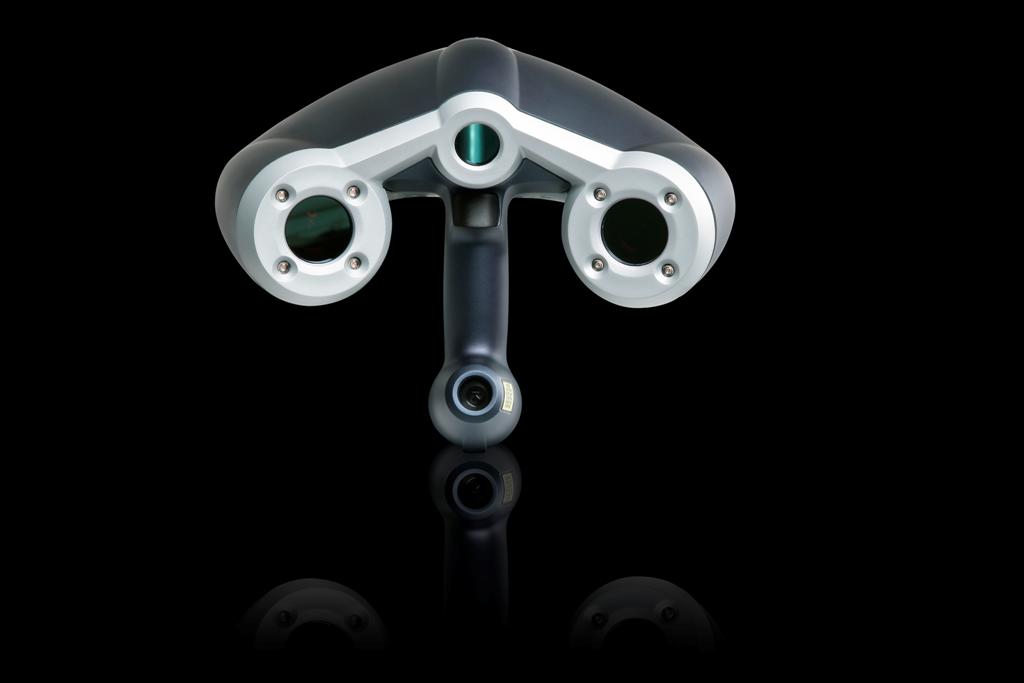
Handyscan 3D has been added to the Cameras section. A main selling point for Creaform's Handyscan laser scanner is its combination of self positioning with mobility.
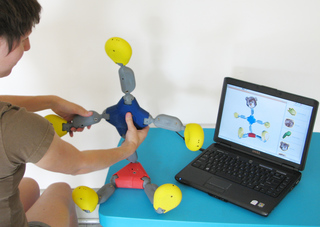
Stanford camera chip can see in 3D Stanford University researchers have developed an interesting new image sensor. Instead of capturing a single planar image it captures multiple overlapping image patches. Software can analyze the overlapping pixels to determine depth in the scene. Another potential use of the technology is to reduce image noise. New Scientist recently ran a story about a "Smart Lego" digital modeling interface developed at Carnegie Mellon University. Posey is a research project that allows the user to model and animate a character or object in real time.
In 2000 MERL had a similar project that was more Lego-like in that it actually used blocks. You can read more about it here. Recently Stanford University announced a project called Dryad. It's a free program allowing users to create three-dimensional tree models for use in virtual worlds and games. Technology Review has a write up on the innovative program. Here's an interesting video from EE Times.
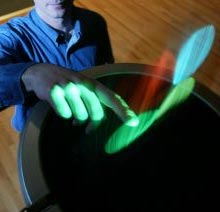
MIT's Media Lab is experimenting with augmented/mixed reality. Check out the video of their "Installation" project. A few years ago 3dcgi reported about 3DV Systems and their ZCam product. At the time it was targeted at television studios with the goal of replacing or augmenting chroma keying. Now the company is attracting attention with a consumer version of ZCam. 3DV is looking for partners so there's not a product for sale yet, but the prototype is the size and shape of a webcam. This time around 3DV is targeting the game industry. Following the success of the Nintendo Wii's motion controller they feel that the ZCam can one up the Wii by allowing players to use any object as the controller, including your hands. ZCam emits infrared pulses and uses the time-of-flight principle to determine a target's depth. Software can use a combination of the depth information and the 2D image to determine what the users is doing. Visit Cnet news.com for some recent press coverage. While they're making the most noise 3DV is not alone in their quest to tap into the gaming market. MESA Imaging has developed similar technology. Brown University demonstrates Drawing on Air system
Panoram's 24-Inch Display Does Hi-Def in 3D
Who shows the best view of 3D 'Beowulf'? Cnet answers this question with a detailed article comparing Imax 3D, Real D, and Dolby 3D. The article briefly covers the technology behind each approach. I won't spoil the surprise of who's best so read the article! Adobe shows off 3D camera tech
Another video can be found at Gizmodo. ITRI demonstrates 3D digital photo frame
The technology behind 3D movies ICT Researchers Win "Best Emerging Technology" Award at SIGGRAPH 2007
Here is the project's web site, Rendering for an Interactive 360º Light Field Display. It includes a paper and downloadable video. Or you can watch the video stream from YouTube. Philips announces WOWzone 3D wall
source: engadget Young Designer's 3-D Display Wins Presidents' Scholarship
This makes two years in a row that 3D related projects have won at the International Science and Engineering Fair. The concept of Hotz's project reminds me of Actuality's Perspecta. Unfortunately I couldn't find video or pictures of the final project, only a blog documenting the reverse engineering of the DLP chip. Samsung adds 3D technology to its High Definition DLP TV Samsung DLP HDTVs run at 120 Hz which incidentally makes them a perfect fit for LCD shutter glasses. Presumably they run at 120 Hz to combat the rainbow affect sometimes seen with a slow moving color wheel. Samsung is making the best of this feature by coming out with LCD shutter glasses and software to turn the TV into a 3D display. ZDnet's David Berlind has a article and video interview showing and describing the product. Maximum PC magazine writer Katherine Stevenson doesn't have a high opinion of current 3D displays and she is certainly not alone in this view. However, Katherine is intriqued by a new player, PureDepth. PureDepth uses 2 LCD screens to simulate depth. This approach reminds me of the DepthCube from LightSpace Technologies, though the DepthCube stacks 20 LCDs and is bulkier and more expensive. 2 LCDs doesn't seem like much, but if they provide a good 3D image at a reasonable cost it might be just the right balance. This YouTube video does a good job explaining PureDepth and its target markets. Recently some researchers from the Japan firm NTT showed off a tangible 3D system that combines a display and a haptic glove. It's similar in concept to the Reachin Display and SenseGraphics' Mobile Immersive Workbench, though it uses a glove as the input device. Technology Review has another article about an MIT project to develop Holographic Video for Your Home. The article covers some details not touched upon in the previous article and has some pictures. Previously we've written about David, software that enables you to use you webcam as a 3D laser scanner. Today we're reporting on another inexpensive scanning system, Milkscanner. You read correctly, milk is what makes the system work. A rig built from Legos holds the camera and serves as a container for the object being scanned and the milk. The system works by filling the container with a little bit of milk, a image slice is captured, more milk is added, and the cycle continues until the object is completely covered by milk. The process is essentially building a 3D texture. Here's a description from the web site.
The web site also contains a video of the process, software, and instructions for recreating the Milkscanner. Source: Gearlog. Fab@Home: 3D objects from your printer for under $2,500 While it's not quite 3DCGI Fab@Home is an interesting project that will need 3D models to drive its creations. Here's a quote,
Technology Review recently wrote about Practical Holographic Video, a project at MIT with the goal of developing a holographic projector that can display the same resolution as analog television for a couple hundred dollars. The current system called Mark III is not ready to be a consumer product as it is monochrome and the displayed image is about the size of a Rubik's Cube. Mark IV should support a full range of colors and be able to display images the size of a desktop PC monitor. Image based modeling programs have been around for a while and most of them require user interaction and many photographs to create detailed models. A new service called Fotowoosh aims to simplify things by allowing anyone to create a three dimensional model from a single photograph. The result isn't as impressive as the detailed models created by other software packages, but the goals are not the same. Techcrunch's article gives a quick overview of Fotowoosh and provides pictures and links to a video. For more in depth coverage check out Technology Review's article. Here are some quotes from the Technology Review article that focus on future improvements to Fotowoosh.
3dcgi has covered a number of 3D cameras that capture static models, but if still images aren't your thing you might want to check out Advanced Scientific Concepts, Inc. Their 3D Video Cameras use Lidar to capture a depth for each pixel. O'Reilly Radar has a link to a Google Tech Talk given by the folks at Advanced Scientific Concepts.
The Light Strokes OptiPaint™ system comes with a Photoshop plugin so there's no need for most artists to learn a new software program. When looking at some of the images and videos in the Gallery you might notice banding in the paint strokes. These bands are actually frame captures and since OptiPaint™ operates at 60 frames per second you'll see these bands if your brush strokes are too fast. As technology improves this limitation will likely go away. This CGSociety article explains the technology behind OptiPaint™ in more detail. If you've ever wondered how GPUs generated realtime 3DCGI checkout Computer magazines article on How GPUs Work. It's written by David Luebke from NVIDIA Research and Greg Humphreys from the University of Virginia and covers the various stages of the graphics pipeline, including the evolution from fixed function to unified shaders. ACM Siggraph recently launched a new service called Encore. With Encore you can watch videos of past Siggraph's including courses, sketches, and papers. As of late February 2007 videos are available for Siggraph 2003, 2004, and 2005. The 2006 videos will be available soon. Want a deal on a 3D LCD monitor? If you pre-order the 22" Widescreen iZ3D monitor before March 15th, 2007 you can get it for $819. After March 15th the price will go up to $999. Note that 3dcgi has not tested this monitor and makes no money in promoting this deal. DAZ|Studio is a "feature rich 3D figure posing and animation tool" with perhaps its most interesting feature being its price, or lack there of. DAZ|Studio if offered free and DAZ is upfront about the reason why.
Check out this page for more free graphics and video programs. Peek through the Looking Glass with LG3D-LiveCD
Roll your own 3D photography on the cheap
Consumer Electronics Show (CES) 2007 News Roundup.
DAVID software turns your webcam into a 3D laser scanner.
The January/February 2007 issue of IEEE Computer Graphics and Applications is titled Sketch-Based Interaction. Along with an introduction to the field articles include:
Checkout this 3dcgi article for a few more examples of sketch based interfaces. Imaginality Unleashed combines 3D modeling with 2D paper. This Beta Preview from MindSpace Solutions enables users to experiment with an augmented reality interface using only the software, some print outs, and a web cam. Recently we reported on a program in development at Microsoft called PhotoSynth. The technology preview is now available. You can find it here. Vizoo Cheoptics360 XL Amazing Holographic Display. This large format display looks very impressive in videos. If it works as well in real world situations Vizoo has a hit on their hands. Here's a quote about how the technology works.
More links: Ramboll, Cheoptics360 mini-site. NTT DoCoMo's Prototype 3D Display To Be Used For Games. This article is about a month old, but it's worth pointing out that NTT DoCoMo is yet another of many that are developing 3D LCD displays using a lenticular lens. If these holograms from XYZ imaging look as good in real life as they do on the web they're sure to be a hit with the public. Many consumers would love to have a full color 3D hologram hanging on their wall, but due to cost the more immediate application for this technology is likely advertising. Seeing one of these in a shop would definitely catch my attention. Gizmodo recently reviewed the iZ3D Three-Dimensional Gaming Monitor with an interesting result. The reviewer was unable to see the 3D effect most of the time. The reviewer's girlfriend however, was able to see the images in 3D so the monitor was definitely working. The iZ3D requires the user to wear polarized glasses which is a proven technology, but this review underscores the potential difficulty manufacturer's might face in taking three-dimensional displays mass market. During Siggraph 2006 Microsoft announced Photosynth, a tool in development at their Live Labs. Photosynth has some ambitious goals including finding similar photos, seeing where pictures were taken in relation to one another, and constructing a virtual 3D scene from a groups of photos. The ability to construct a virtual 3D scene is what attracted a lot of press, but unfortunately the first public release of Photosynth won't include this feature. This is due to the large amount of processing necessary to create the virtual scene. Microsoft's web site describes the scene creation process. The quick summary is they use computer vision techniques to identify features of each photograph and then try to find other photos with the same features. So for this to work you'll need a lot of photos of a single area. Viewing 3D holograms that float in mid-air without the need for special viewing equipment like glasses is a dream shared by many. A London based company called Phoebe Ltd. claims to have achieved this dream and they are in the process of commercializing their technology.
Phoebe is targeting an array of markets ranging from defense to cell phones with units that range in size from mobile phone to 6 meters square. We will keep an eye on Phoebe and keep you informed of further developments. At Siggraph 2006 StereoVision Imaging, Inc. was showing off some stereoscopic binoculars. These nifty binocs are called the 3D VuCam and they function as a digital camera that captures a stereo pair of images. Some specs include 8x magnification and a 3.1 Megapixel resolution, priced near $2000. 3-D Scanner Wins 2006 IEEE Presidents' Scholarship.
An impressive feat for anyone, let alone a 2nd year high school student. Dolby to Bring 3D Imaging to More Theaters Everywhere.
The BumpTop desktop interface from the University of Toronto's Dynamic Graphics Project has some intriguing aspects. It's a three dimensional computer interface with physics. Windows Vista will be 3D underneath, but it won't work like BumpTop. BumpTop allows you to stack icons, flip through them, and toss them about in any manner you please. It's designed to simulate the way people "organize" their desks in the real world. Check out the video to see how it works for yourself. Note that BumpTop is a research project so you can't yet download and install it. Archipelis has an ambitious goal, to infer a three dimensional object from a two dimensional shape. Its goal is to make modeling organic objects in 3D easy and fast. A short animation can explain the concept better than words and there are a few animations on Archipelis' main page.
You may have heard that Google recently bought @Last Software, the creators of SketchUp. Well, today Google announced a free version of SketchUp. If you need to export to file formats used by other programs you'll still need to buy SketchUp, but if you only want to create some cool models the free version should suit you nicely. When many people think of 3D displays they think of Princess Leia's message in Star Wars. In a Flash demo at their site Provision Interactive claims this three dimensional projector has arrived. Here's a quote from their web site.
Fakespace Offers Beacon 8MP with 8.85 Megapixel Resolution While this is really just very high resolution projector that will only be bought by a few companies or research institutions the article makes a good comparison between the two stereoscopic methods the projector supports. With the Beacon mode you must wear LCD shutter glasses that are usually relatively expensive and bulking compared to simple polarized glasses. However, there is a possibility for crosstalk between the left and right images with polarization. Since the projector supports both you can take your pick. Many news sites are reporting about some interesting 3D display research. Here's a snip from DailyTech.
Stereoscopic High-Def Videocam
Hitachi demoed a small 3D LCD Display at CES 2006 and Anandtech was there to take pictures. Mechanical Engineering Magazine recently ran an interesting article titled "Design with Depth". It gives a good depiction of how mechanical design is limited by two dimensional displays and how three dimensional displays can help. Profiled companies include LightSpace and Actuality. Display polarization seems to be gaining popularity. The other day we reported about Polaris and next up is IBM. Like Polaris, IBM's methed requires the viewer to wear polarized glasses. The lenses are clear so colors will be crisper than the old style red and blue glasses. IBM's approach is different in that it works with DLP displays instead of LCDs. This should mean it will be easier to manufacture large displays for home theaters. The News.com article has a video that shows the display in action. Of course you won't actually see the 3D effect in the video. Previously we've seen a lot of manufacturers announce glasses free 3D displays and most of them have used lenticular techniques which limits the horizontal resolution. Polaris Sensor Technologies Inc. is different. They stack two LCDs and use polarization to direct the appropriate image to each eye. The downside is the need for polarized glasses, but given a comfortable pair the high quality might be worth the cost. Their web site briefly explains the various 3D display technologies in use today giving some pros and cons for each approach. It's a good refresher even if you are somewhat familiar each technique. Polaris has been added to 3dcgi's 3D Display page. There's a new online magazine for 3D digital artists called 3DCreative. It's published monthly and cost money to download, however there is a Lite version that's free to download. The Lite version is well done. It shows every page of the magazine although not every page is big enough to read. Check it out here. As the premiere conference on computer graphics and interactive techniques Siggraph 2005 drew a large number of attendees (29,122) but not much in the way of mainstream press coverage. But never fear, 3dcgi has rounded up some articles covering various aspects of the conference ranging from papers to the emerging technologies pavilion. The articles are listed in the order in which they were found. EE Times - Emerging tech lights up Siggraph. This will be old news to some, but it was never reported here. In late 2004 eDimensional announced their 3D glasses now support LCD displays. Previously the lack of a CRT like refresh made it difficult for shutter glasses to present stereoscopic images to LCD users. If you have an LCD and would like to play games in stereoscopic 3D this is great news. Gamasutra and many other news outlets are reporting that Natural Motion has released a free learning edition version of their Endorphin animation software. If you yearn for something different than keyframe or motion capture based animation Endorphin might be what you're looking for.
A new article from Tom's Hardware Guide titled 3D Stereo Technology: Is it Ready for Prime Time? discusses many of the 3D display technologies on the market. The article starts with explaining how depth perception works and goes on to discuss technologies like anaglyph, head mounted displays, LCD shutter glasses, autostereoscopic displays. The more interesting part of the article for returning 3dcgi readers is the part about German display manufacturer A.C.T. Kern. It explains some of the technology behind their Free2C displays. Free2C technology is licensed from the German Fraunhofer Institute. IO2Technology has an interesting free-space display called Heliodisplay. The image floats in mid-air above the display unit, doesn't require glasses to view it, and can even be touched. The image is projected in two dimensional space, but supposedly the images appear to be three dimensional when viewed from more than a few feet away. The videos available on the web site seem to corroborate this statement.
The Heliodisplay technology is patent pending so IO2's web site doesn't contain much technical information. The displayed images are up to 22" diagonal and all the video sources you'd expect are supported. Touching the image provides no physical feedback, but a finger can be used as cursor, turning the Heliodisplay into a virtual touchscreen. Portable stereoscopic imaging on the go. That's what you get with the DepthQ Stereoscopic Video Projector by Lightspeed Design. At 6.8lbs this projector is light enough to travel with but it seems like it would be more fun with games and movies. High def resolution would be ideal, but the DepthQ's native resolution of 800x600 isn't bad considering the $3495 asking price. To view this 3D video you'll need active LCD shutter glasses like those from eDimensional. Toshiba announced it will throw its hat into the ring and start selling 3D displays. Commercialization is still a couple years away though. Their entry will be of the flatbed variety. Think tabletop. A new article from the IEEE's Spectrum magazine, called 3-Deep, does a terrific job summarizing the state of the glasses free 3D display market. Profiled technologies include swept volume displays like the Perspecta from Actuality and stacked LCD technology. Intel claims its new "computational nanovision" software technology can increase an image's resolution by at least two times. According to a news story at Tom's Hardware the software extracts details from multiple images and creates a single "super resolution" image. The technology can also be used for 3D surface recontruction. Computational nanovision sounds very similar to some NASA technology we reported on over a year ago. The Museum of the Moving Image in Astoria, Queens is getting a makeover and the new attraction is a virtual reality room or CAVE. Visitors will be provided with stereo glasses in order to see the 3D imagery. Read more about it at The New York Times. Registration may be required.
|
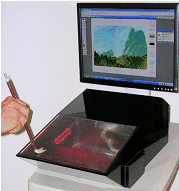 Here's an interesting concept. A paint system that allows artists to use real brushes and even their hands instead of a stylus or mouse. You don't really use paint with the brushes, but you do use water.

 Next
news page
Next
news page